
AI, Authenticity, and the Black Experience with Bria Porter on Martha’s Vineyard.
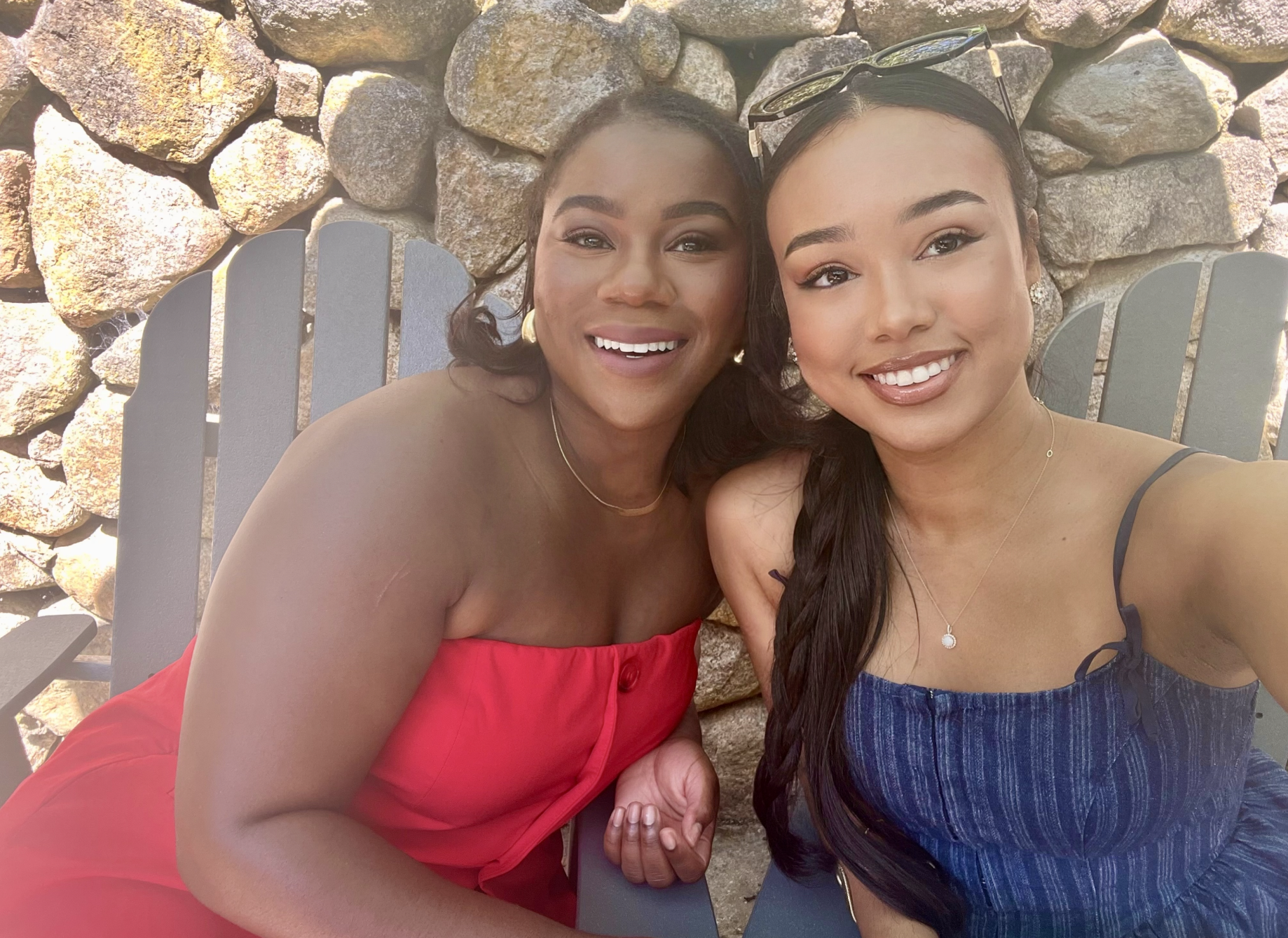
Bria (L) and Rachel (R) pictured smiling.
Transcript from That Martech Girl Podcast Interview with Rachel Gray and Bria Porter.
Rachel Gray: Hello and welcome back to episode five of that martech girl, the podcast where martech meets culture, the business podcast with personality. I'm your host, RG:, and today we are coming to you live from Martha's Vineyard. I'm joined by my dear friend and second time guest on the podcast, Bria Porter. She was on for season one. She's a veteran in the martech industry, but I'll have her introduce herself later on, we're going to be discussing several important topics, the first of which is AI and the black experience. How can we as a black professionals, use AI to our advantage during the AI revolution? Secondly, we're going to talk about the environmental and equity implications of AI. And finally, we're going to discuss what brands should be doing since it's the end of the year right now, in order to prepare for 2026 especially because we are in this extremely important time in history with AI, let's get into it.
Hi, Bria, thank you so much for coming back to that. Martech girl,
Bria Porter: I am so glad to be here. Rachel, thank you for having me.
RG: Of course, if you guys remember, Bria was here last season, and we introduced you guys to Bria. She's been in the marketing industry and the marketing technology industry for quite some time, but if you could reintroduce yourself to the people, just let them know what you do, both at your day job and your business, we would love to hear that
BP: Absolutely so I am an engagement analytics supervisor under FCB health, or IPG health, which is one of the leading pharmaceutical advertising agencies In the world. And I also have my own small marketing boutique called coyote agency, and we support small businesses looking to build sustainable growth. And yeah, that's pretty much who I am. Yeah, I'm here.
RG: Yeah. So actually, we are here together. Usually I'm recording over teams or Riverside virtually. But today we are on Martha's Vineyard together, and just now we were out shooting content for her business. And now we're like, let's record an episode. But I spoke to Bria, maybe, like, I don't know, six, seven months ago was it? And I was like, we should make the track to Martha's Vineyard the
BP: One of the best decisions made, my favorite decision of the year. I'm so happy to be here and building with you and just, you know, spending girl time.
RG: Yes, this is, this is great. I mean, we've seen like through social media, just like how black wealth has been propelled at Martha's Vineyard, and we were curious. We're like, let's come check it out for ourselves. And I think we've been able to really see community here and eat some great food as well. Yeah, yesterday we went to, what was it Pelican,
BP: Pelican Club in Edgartown.
RG: Yes. So I think Edgartown is my favorite. What's your favorite?
BP: I gotta say Oak Bluffs. Oak Bluffs is my favorite. But Edgartown is beautiful. Reminds me of like, Georgetown, DC, yeah, that kind of vibe is so very elegant and elevated. But if you're coming to Martha's Vineyard and you want that black experience to experience biscuits, or c'est la vie or yoga on the beach. You're gonna want to be in Oak bluffs. Yeah? And I feel like that's where a lot of our folks are, and that's where they were historically, even, too, you know, on the vineyard. So, yeah,
RG: Last night we went to known ins Nomen's
BP: Nomann’s.
RG: Yeah, sorry, guys, Nomann's.
BP: That was jumping.
RG: It was great. It was great. We're old though, you know, so we're like, all right, retire. Let's go home. But it was great to see just community out like that, just vibing having a great time. It's Labor Day weekend, so this is just a time to just be with community and be free have great time. So yeah, talking about the black experience, we had a conversation last night at dinner, and I was like, It's too bad we don't have the podcast mic here today, because we were talking about AI, which is the topic, and kind of the theme of the season, and the black experience, the things that we need to be working on as a community To make sure we're ahead of the curve, and also the complexities of this issue within our communities as well. And you had a lot to say about that.
BP: 100% you know, just first and foremost, I love that. I love seeing us in tech. I love seeing us in STEM there's so many of us, and I think that engaging in AI, whether you're building a product or using it to support your work, that provides a competitive edge, that allows us to stay within the present and even look forward in the future. And then there's also the fact of energy, and the use of energy when we're using AI, and how much it requires, and how that affects our direct communities or communities that are underserved or lacking resources. And that's not all of us, you know, I think some of us have been able to be in a space where we've made a way for ourselves financially, but that doesn't impact communities of color, essentially, you know?
RG: Yeah, yeah, I think so. The main things we called out was prompting, right?
BP: Yes.
RG: We talked about how it's affecting the community that you just talked through just now. And I think the other thing we were talking about was we're at the end of 2025 oh my god, and we're moving towards 2026 and not just as black communities, but as brands, and thinking back at marketing technology as a whole, like, how can we prepare for 2026 as brands and having that focus? So let's start with the prompting,
BP: Yes.
RG: And just talking through like inclusive prompting, and how exactly we're dealing with that issue?
BP: Yeah, there's a really cool agency, Creative Theory. They're at based in DC, and I remember they did like a micro site with a call to action for inclusive prompting, because even even small things not related to exclusively race, but even gender, what it looks like to build out a visual character or a visualization of somebody, and is it ironically stereotypical, or is it actually depictively accurate to what that person may look like, or what they may be experiencing? So feeding these engines or these LLMs with Inclusive visualization so they can be accurate, they can be precise and they can be inclusive. Is Super imperative, right? Yeah.
RG: Also, last last week, on the episode, I was talking about making sure that the AI tool that you invest in is malleable and can speak to your brand voice and talking about inclusivity, that's also important, because your brand voice might be inclusive in theory, and then you're using kind of AI to prompt for you and create content, but then that content turns out to a that kind of doesn't reflect that inclusivity. So being able to first invest in a tool that's malleable, to learn your brand, voice, learn your inclusive messaging, et cetera, so that when you produce that content via AI, it can come out in an inclusive way.
BP: Yeah. I mean, I think one of the problems I was reading about AI in film and that precision you'll feed it and you'll train it, and then it might not even bring out the same output each time. So there's a lot of work that LLMs and AI in itself can use. But I think the more we feed it, the more can understand where we're going, and that prompt precision is so super important.
Coyote itself. We have more of a colloquial, relaxed brand voice. We're still very informed, but it's chill and it's accessible.
And I want when we're using chatgpt or Gemini, when we feed it, and we are asking it to help support the script and the copy that we're writing, I want it to make sense and align with how we sound in our brand voice.
RG: But you know, I think that has a way to go in terms of chatGPT and Gemini. Because Have you ever, like, had or watched a film where it is I'm Jamaican, right? It's like somebody who's not Jamaican trying to speak patois. Oh my gosh. That's how chatGPT feels right now. Yeah, yeah,
BP: I know I could completely understand that it can seem inauthentic, and I don't lean on chatgpt to, like, create the base of our copy. I have a really close friend, Essence Rogers, who's amazing. She's an excellent copywriter, copy editor, and I have her start that basis, or I'll work with something and I'll feed it, and then that's how we train it, right? Because it can be inauthentic, right?
RG: Yeah, and that's something to watch out for, because, yeah, inclusive messaging as a concept is great and all, but in actuality, it can come across inauthentic so easily.
BP: You have to be careful with it, but I have hope that it will learn. It's getting smarter all the time, right? And the way that people are using these things, like they'll source off of each other, there's actually some like, legal things going on with two large LLMs right now about whether they can feed off of each other or not. It's gonna, it's gonna get smarter, it's going to get better. And right now, it might be a little bit cheeky, but that's where you tweak it and you make it your own, and you might start with your own language first, right?
RG: So I think the takeaway here is we're not where we need to be with the LLMs Currently in order to have, like, an inclusive tone. I don't think we're there. We need to first start with the bones and then have the LLM kind of expound on it from there. Would you agree?
BP: Yeah, yeah, yeah. I think everybody's people that are using this in any capacity are saying you can't rely on it and let it be your your bones, your foundation, your base, you have to already have a strength in that area and then allow it to, you know, enhance exactly what you just said, yes, yes.
RG: Moving the conversation now to environmental and equity implications of AI, we had an interesting conversation yesterday about that, because I don't think, I don't think that's a topic right now. The topic right now is like, Well, how do we use it? What do we do with it? How do we implement it? But the implications are kind of being left to the wave side, and yes, as a community, we still need to be engaging, but I think it's also important for us to be aware.
BP: Yeah, I mean, I felt like I was coming in, like, how do I use this chat? GPT, all right, let me how do I use it to my advantage? And then, like, a lot of my homies that use it, that are black or of the Diaspora were the ones that flagged to me. They were like, I don't it takes mad energy. I don't use it. Or if I do use it, it's like, impacting our communities greatly. And that's where I was like, Oh, let me become better informed about what's going on. And I still have a lot to learn. Yeah, but it is a flag, and it does make me think and give pause in a moment of all right, if I'm going to use these open source you know, solutions, what am I doing to my environment, and not just, not just communities of color, but the environment overall.
RG: And my brother, who is in hard tech, deep tech, which is actually building tech like green technology, to be able to impact the future. So something I brought up last night was, you know, what are the solutions to this issue? We know we have the advancement with AI, and we know that there is some environmental impacts, but what are we trying to do in order to lessen that impact? And where are those solutions, and which are the companies that we can highlight and try to fund in order to get that impact decreased as well?
BP: Yeah, 100% I think those are great questions. So, yeah, yeah,
RG: But I do think that it shouldn't lessen our want to be able to use AI and implement it.
BP: Yeah. I mean, my desire hasn't changed. My actions certainly haven't changed. I hope I don't regret this in a couple of years, and I'm like, this is a cancelable sentiment, but I really appreciate using AI. I appreciate allowing it to be a solution that supports what we produce, and I also appreciate it helping us create products for our customer base, because it's brilliant, and especially with small businesses, things like stock photos, things like creating an email campaign that makes sense, or understanding how to develop positioning that doesn't come easy and that can be really expensive, but AI allows them, as small businesses, to create marketing solutions. AI allows them to create tactics and assets and just make decisions in a way that has not been as easily accessible before, and that's what makes the difference.
RG: So it's kind of creating equity.
BP: I would say.
RG: Across the board.
BP: I would say, if you're using it right, you can be powerful with it,
RG: Right? You know, so like, not only for small businesses, but also for our communities.
For our communities, yeah, it can level the playing field.
BP: I would say. So I think, you know, we were in the past, and I don't know much about the 50s and 60s, but I know enough to know that there were so many small businesses, and, you know, on a community level, they supported each other, and as we are now on the worldwide web, and that's how we're like, we have these digital communities, you need solutions that support in this way, because it's not only just foot traffic, but it's, it's the strategy, it's being seen in the world so you're not drowned out. And you have to use this to help leverage.
RG: I like that. I like that. I never thought of it that way before, where, like this is actually creating equity for our communities and for, like, small businesses as well.
BP: I think it's a it's a way to level the playing field if you're if you're smart enough with it.
RG: Yeah, but that's why we need to understand prompting, we need to understand agents. We need to understand really, like the ins and outs of AI as soon as it starts and hits the market, because otherwise being able to fully utilize the tool it, it won't be something that we can actually do. Yeah, so it's very important.
Now finally, in turning the focus to next year, oh my goodness, it's almost 2026.
BP: I'm ready. I'm ready.
RG: Why are you ready?
BP: I just know what I'm doing with the end of the quarter.
RG: I love that.
BP: So I'm gonna have a great close of this year. I'm going to enjoy working and doing Christmas things. It's my favorite holiday.
RG: Yes, yes,
BP: but as a brand, I think that we need to be thinking about this like we're already in 2026
We shouldn't be in 2026 planning for 2026 or at least the first half.
RG: And that's a thing I see a lot with companies, like on a corporate scale, I work with Fortune, like 100 companies, and it's always like pushing out, okay, well, this is for our 2026 roadmap.
But they take forever to plan for that time. It's like they're, they'll, they'll wait to the very last minute to pull the trigger on whatever it is, whether it be an actual marketing technology tool or whatever, but they'll push it out as far as it can go. But I think that this year, especially if you're going to be the brand that is at the forefront of AI and really making moves and utilizing it to the best of its ability, you cannot wait, yeah, like, lock yourself in a room, figure out the strategy and implement
BP: I was talking to Essence, and she was like, we should already have our content calendar done right For 2026 at least for q4 your content calendar should be ready to roll out. You know what you're doing, because this is when brands are even planning their budgets. So by August, if you're a business and you are looking for sponsorship or partnerships, know that your partners and your sponsors probably already know how they're spending their money or making plans on how to spend their money. And you can get in right now in August by sending them an email. You know, get them dollars early.
RG: Yes, it's time. Budgets usually open up around October. Now is the time and and this planning needs to take place right now in September, because you need to know what you're going to spend that money on in October. So needs to happen right now, if you don't have an AI strategy, figure it out and implement and I think like just having a plan is better than no plan, yeah, and kind of just sitting there thinking of ideas, find a strategy, stick to it and say it doesn't work out, at least you tried.
BP: Yeah, I think that's the hard part too. Is like sticking to it. A lot of times, teams are quick to pivot because they're not seeing it work. But you know, you got to plant those seeds, because you never know when it could arise, or how could arise, if you give it a good six months, I think that's plenty of time to say, Okay, we stuck to it for six months now, let's change.
RG: Yeah, yeah, that's a very good way to think about it.
And I think it's easier to pivot if you have an original plan that you outlined. Like I don't think the plan always remains the same in the end, like there and think about life, it's like that, right? I can think through my own life where it's like I had a plan. Did I reach the end goal that I thought I was going to reach in the beginning? No, however, creating that plan and just going through that exercise was so helpful, because in the middle it's like, okay, well, now I can pivot. Now I can use resilience in order to figure out, like my next step. But having the groundwork and laying the groundwork out was essential, I think, is the same thing applies to business.
BP: Yeah. I mean, with with brands, through IBG, we create measurement and learning plans. What do we want to measure? What are the KPIs that are important to us, and then also, what do we want to learn and understand? It's not always about like, are we translating this into money immediately? Sometimes it's like, how are our users engaging with this content? And that's important to know to help inform the pivot, because you do have to change at some point in life. There is an evolution that's necessary, right? But you should have an understanding of, like, what you want to learn, and at the end of those six months, or at the end of that time period, you're like, all right, I got the understanding now, and this is how we pivot.
RG: Right. Because I think what holds people back, both personally and in business, is fair. It's like, okay, this is moving so quickly we don't know we're going to have to pivot in two to three months. Okay, but create your strategy and your plan and then pivot. You can tweak, but it's it's even worse if in two three months, you're creating that plan from scratch. Again, yeah.
BP: What is it “having no plan is a plan to fai”l?
RG: Exactly, exactly. Well. Thank you so much, Bria for your time. Today, we had a wonderful episode here in Martha's Vineyard, and we're gonna go and explore
BP: Edgartown.
RG: Yes, we're gonna have a great time. Thank you all for listening, and we'll see you next.
BP: See you.
RG: Thank you so much for tuning in to this episode of that martech girl. Please don't forget to follow us on whatever streaming platform that you are listening to this episode on, and follow us on Instagram and LinkedIn at that martech girl, also, we will be at Opticon next week, September 10, so don't forget to get your tickets as well. Your support is greatly appreciated. Come back next week. We have so much more in store. Have a wonderful rest of your week. Bye, bye. You.
Transcribed by https://otter.ai